Platform Specification
Once the plugin has been loaded, it can be in one of the following states:
STATE_UNINSTALLEDSTATE_INSTALLEDSTATE_ACTIVESTATE_DEACTIVATEDSTATE_DISPOSED
Refer to the following state diagram for an overview of the full lifecycle of a Plugin:
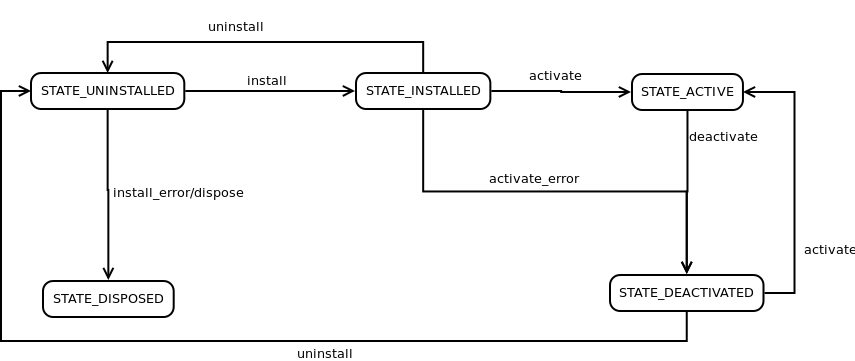
Each plugin starts with a creation of PluginContainer. A PluginContainer is a container and a wrapper around a Plugin and it is a primary representation of a plugin in the Platform.
A PluginContainer holds references to the PluginResource (an abstraction for easy access to the plugin bundled resources), to the plugin hook objects (as exposed by the Plugin Manifest), and to a list of the exports and dependencies for this plugin (as exposed by the Plugin Manifest).
Once a PluginResource is created, and thus the initial structure of the plugin bundle has been confirmed to be valid, a Plugin will be put in the STATE_UNINSTALLED state.
Resource Loader object protocol:
class ResourceLoader:

    def load(self, str_rc_id_specs, *args, **kwargs):
# perform the lookup and load hereThe resource ID string specification is as follows:
[[<protocol>:]...]<resource_id>
where:
-
protocol- protocol which determines the means of accessing the resource (e.g.file,plugin,classetc) -
resource_id- the actual resource ID. In the context of the access mechanism (protocol handler), this may be: the file path, the name of the plugin, the full class name, etc
plugin:core-event-loopfile:conf/platform.iniclass:nanopp.platform.Platformsingleton-objectbca87585-18bd-440f-87a9-7cc44e56a639
or, some complex ones:
plugin:tar.gz:my-plugin-2.3plugin:zip:ui-plugin.zipfile:zip:archive.zip/someFile.txt