


This repository provides the official implementation of Parallax from the following paper:
Parallax: Parameterized Local Linear Attention for Language Modeling.
Yifei Zuo, Dhruv Pai, Zhichen Zeng, Alec Dewulf, Shuming Hu, and Zhaoran Wang. arXiv preprint, 2026.
Parallax is an upgrade to Softmax Attention. It is a scalable form of Local Linear Attention (LLA), a mechanism with provable theoretical advantages over Softmax Attention (see FlashLLA for the LLA kernels). Parallax and LLA are not linear complexity attention mechanisms. They share the computational structure of Softmax Attention and require KV cache for decoding. Optimizations such as sliding window and block-sparsity are structurally compatible with Parallax.
- Flash-Linear-Attention: Parallax kernels available in the
flalibrary. - Modded-NanoGPT-plx: Parallax for the
Modded-NanoGPTspeedrun.
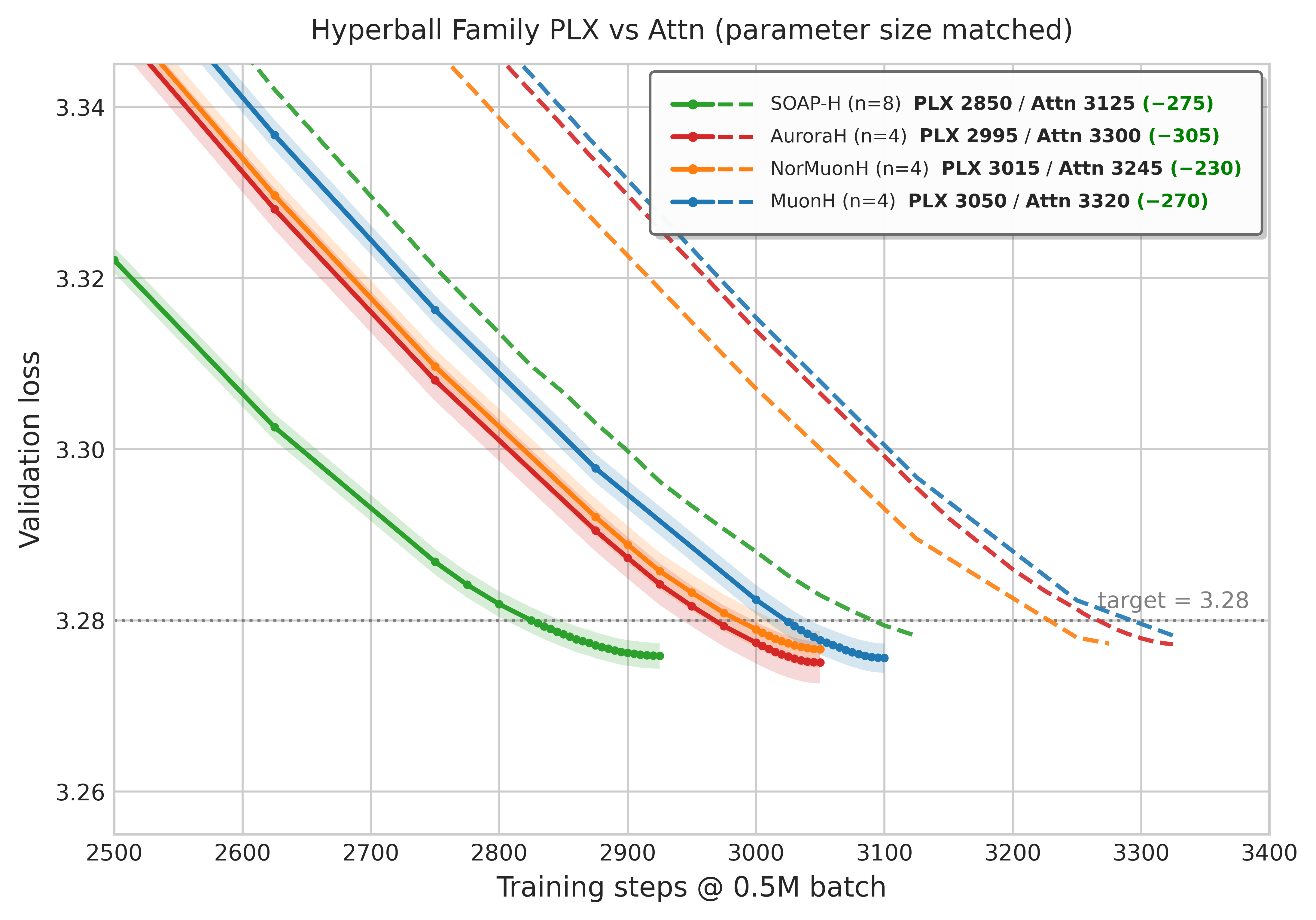
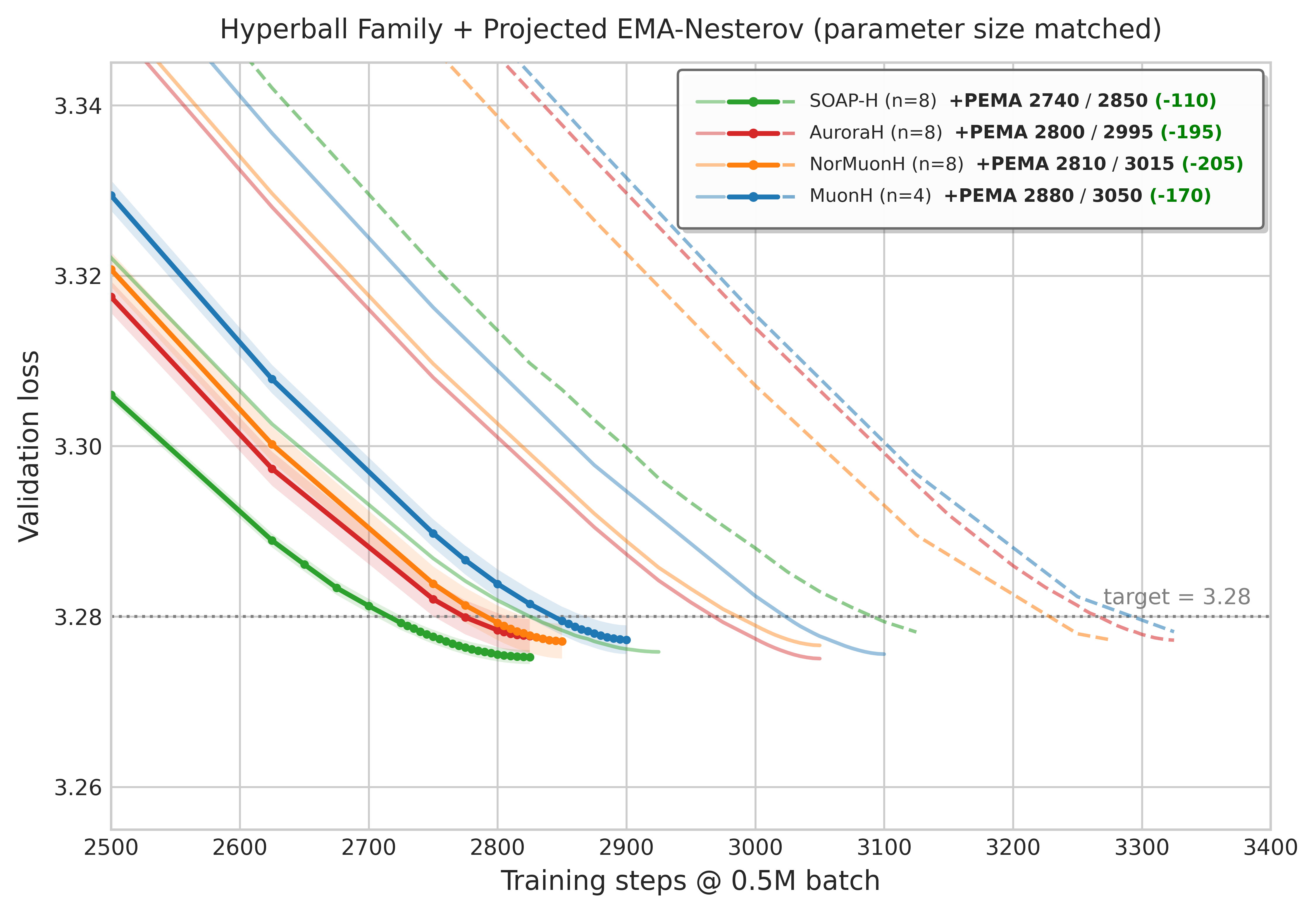
Triton and Helion each provide training (dense + varlen) and decode kernels.
CuTeDSL provides the decode kernel only.
Triton kernels and the fp32 reference:
pip install parallax-kernelAdd the Helion kernels (experimental):
pip install 'parallax-kernel[helion]'Add the SM90 CuTeDSL decode kernels (pins torch 2.9.1 / triton 3.5.1):
pip install 'parallax-kernel[cutedsl]'For development or the bench and parity harnesses, install from source:
git clone https://github.com/Yifei-Zuo/Parallax.git
cd Parallax

uv sync                # core; add --extra helion / --extra cutedsl as needed
uv sync --group bench # bench harness: pinned stack + FA2 + pytestNote: our current kernels are developed and tested on NVIDIA Hopper GPUs. A reference PyTorch implementation is provided in
parallax/reference.pyfor correctness verification and as a starting point for custom implementations on other hardware.
import torch
from parallax import parallax_func

B, H, L, D = 2, 8, 1024, 128
q = torch.randn(B, H, L, D, device="cuda", dtype=torch.bfloat16, requires_grad=True)
r = torch.randn(B, H, L, D, device="cuda", dtype=torch.bfloat16, requires_grad=True)
k = torch.randn(B, H, L, D, device="cuda", dtype=torch.bfloat16, requires_grad=True)
v = torch.randn(B, H, L, D, device="cuda", dtype=torch.bfloat16, requires_grad=True)

o = parallax_func(q, r, k, v) # (B, H, L, D), causal
o.float().pow(2).mean().backward()import math
import torch
from parallax import parallax_decode
B, H, D = 4, 8, 128
kv_len = 4096
q = torch.randn(B, 1, H, D, device="cuda", dtype=torch.bfloat16)
r = torch.randn_like(q)
k = torch.randn(B, kv_len, H, D, device="cuda", dtype=torch.bfloat16)
v = torch.randn_like(k)
o = parallax_decode(q, r, k, v, qk_scale=1.0 / math.sqrt(D)) # (B, 1, H, D)Helion implementations of all three kernels
— autotuned, compiled to Triton — live under parallax.helion with the same
entry-point names and signatures:
from parallax.helion import parallax_func, parallax_varlen_func, parallax_decodeOn H100 (full autotune + CUDA-graph replay) vs the Triton kernels above:
training step (fwd+bwd) 0.84× geomean latency across a 17-shape grid,
varlen 0.53×, decode 1.8–6.4× faster. Precision: q50 max-norm relative
error < 1e-2 vs the fp32 reference for the output and all four gradients
(scripts/test_*_helion.py).
Helion autotunes on first call per shape — minutes per new shape with
HELION_AUTOTUNE_EFFORT=full (cached via HELION_CACHE_DIR), immediate but
slower with =none. For production, pin tuned configs — see
Helion's deployment docs.
scripts/bench_decode.py benchmarks the decode kernel against FA2 and
FA3 with combined speed + precision reporting:
python scripts/bench_decode.py                       # example sweep
python scripts/bench_decode.py --include-fa3         # add the FA3 column
python scripts/bench_decode.py --parallax-grid \
                               --csv runs/bench.csv  # 216-shape grid, save to CSV
The numbers below are measured on a single NVIDIA H200 SXM (132 SMs)
with bf16 inputs and head dimension D = 128. Latency is the q50
over a CUDA-graph replay sweep (q05 and q95 are within ±1% on
every row). Accuracy is the worst per-element relative error against
the fp32 torch reference (parallax.parallax_reference).
Small batch (B = 1, H = 8, D = 128)
| L | FA2 (µs) | FA3 (µs) | Parallax (µs) | Parallax max-rel-err |
|---|---|---|---|---|
| 512 | 8.38 | 10.64 | 5.79 | 2.1e-3 |
| 1024 | 9.45 | 9.10 | 6.48 | 4.0e-3 |
| 4096 | 17.07 | 11.90 | 8.61 | 2.0e-3 |
| 16384 | 29.82 | 24.46 | 21.53 | 2.7e-3 |
Large batch (B = 32, H = 8, D = 128)
| L | FA2 (µs) | FA3 (µs) | Parallax (µs) | Parallax max-rel-err |
|---|---|---|---|---|
| 512 | 27.73 | 23.48 | 24.02 | 3.6e-3 |
| 1024 | 99.73 | 39.16 | 39.55 | 3.4e-3 |
| 4096 | 384.90 | 281.64 | 279.96 | 3.6e-3 |
| 16384 | 1574.94 | 1096.76 | 1094.37 | 3.2e-3 |
Reproduce the small-batch table with:
python scripts/bench_decode.py --include-fa3 \
    --shape 1,512,8,128  --shape 1,1024,8,128 \
    --shape 1,4096,8,128 --shape 1,16384,8,128 \
    --warmup 100 --iters 50 --trials 20
Reproduce the large-batch table with:
python scripts/bench_decode.py --include-fa3 \
    --shape 32,512,8,128  --shape 32,1024,8,128 \
    --shape 32,4096,8,128 --shape 32,16384,8,128 \
--warmup 100 --iters 50 --trials 20@misc{zuo2026parallaxparameterizedlocallinear,
title={Parallax: Parameterized Local Linear Attention for Language Modeling},
author={Yifei Zuo and Dhruv Pai and Zhichen Zeng and Alec Dewulf and Shuming Hu and Zhaoran Wang},
year={2026},
eprint={2605.29157},
archivePrefix={arXiv},
primaryClass={cs.LG},
url={https://arxiv.org/abs/2605.29157},
}MIT. See LICENSE.