CLI-first harness for benchmarking guardrail, moderation, and safety classification models.


Evaluate any safety model — local HuggingFace, vLLM, OpenAI, Anthropic, or custom API — against 80+ built-in safety benchmarks with a single command.
pip install geh

# Run a quick eval
geh run --dataset xstest --model mock --limit 50

# Run multiple datasets
geh run --dataset xstest,toxic_chat,harmful_qa --model hf \
    --model-name meta-llama/Llama-Guard-3-8B

# Run from a YAML config
geh run --config examples/run-mock-jsonl.yaml

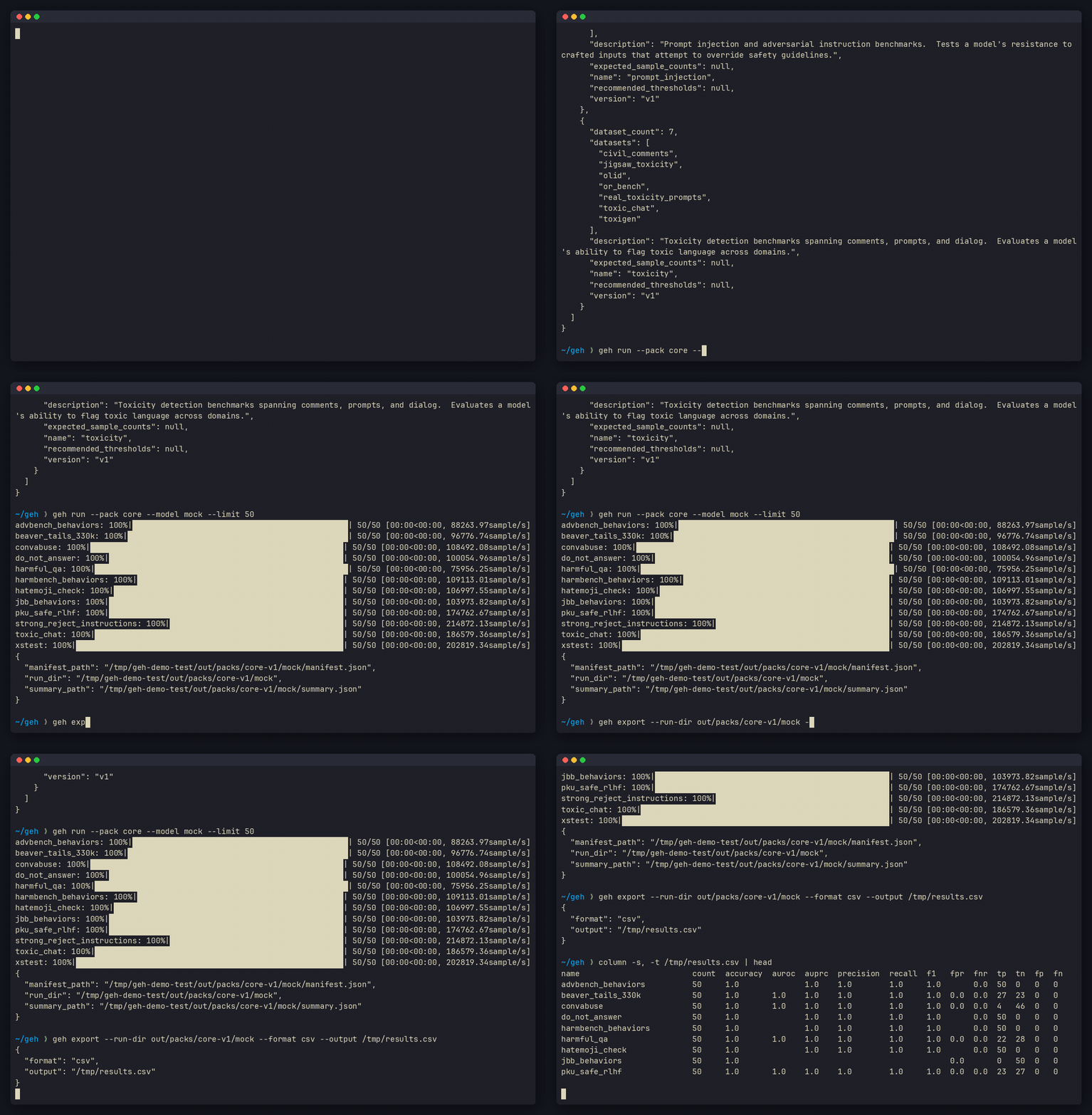
# Use benchmark packs
geh run --pack core --model mockRequires Python 3.10+.
# Base install
pip install geh

# With HuggingFace model support
pip install "geh[hf]"

# With vLLM support
pip install "geh[vllm]"

# With API model support (OpenAI, Anthropic)
pip install "geh[api]"
From source (for development):
git clone https://github.com/Virtue-Research/guard-eval-harness.git
cd guard-eval-harness
pip install -e ".[dev]"
Copy .env.example to .env and fill in the API keys you need.
The fastest way to run evals — no config files needed:
geh run --dataset <dataset> --model <adapter> [--model-name <name>] [options]# HuggingFace model on XSTest
geh run --dataset xstest --model hf --model-name meta-llama/Llama-Guard-3-8B
# OpenAI moderation
geh run --dataset xstest,toxic_chat --model openai_moderation
# vLLM serving
geh run --dataset harmbench_behaviors --model vllm \
--model-name meta-llama/Llama-Guard-3-8B --batch-size 32
# Limit samples for quick smoke tests
geh run --dataset xstest --model mock --limit 10For full control over model args, dataset options, execution tuning, and output:
geh run --config examples/run-mock-jsonl.yamlSee examples/ for sample configs.
Curated dataset bundles for common evaluation scenarios:
geh list packs
geh run --pack core --model mock
geh run --pack jailbreak --model hf --model-name meta-llama/Llama-Guard-3-8Bgeh list datasets # 80+ built-in safety benchmarks
geh list backends # Available model adapters
geh list packs # Curated benchmark bundles
geh list metrics # Supported metricsgeh inspect --run-dir out/my-run # View manifest, summary, artifacts
geh report --run-dir out/my-run # Rebuild HTML report
geh compare --run-a out/run1 --run-b out/run2 # Diff two runs
geh export --run-dir out/my-run --format csv --output results.csvEach run writes a self-contained directory:
out/my-run/
  manifest.json              # Run metadata
  resolved-config.json       # Exact config snapshot
  summary.json               # Aggregated metrics
  report.html                # Static HTML report
  datasets/
    <dataset>/
      predictions.jsonl      # Per-sample predictions
      metrics.json           # Dataset-level metrics
      dataset-manifest.json  # Dataset metadata
| Adapter | Description |
|---|---|
mock |
Deterministic mock for testing |
hf |
HuggingFace Transformers (local GPU) |
vllm |
vLLM inference server |
openai_compatible |
OpenAI-compatible APIs |
openai_moderation |
OpenAI Moderation endpoint |
anthropic |
Anthropic Claude API |
http |
Generic HTTP endpoint |
80+ built-in safety benchmarks spanning two modalities:
The core modality — evaluate text-based guardrails and moderation models across a range of safety dimensions:
- Jailbreak / adversarial: XSTest, HarmBench, JBB Behaviors, AdvBench, Do-Anything-Now, StrongREJECT, MaliciousInstruct, WildGuardMix
- Toxicity: ToxicChat, ToxiGen, Jigsaw Toxicity, Civil Comments, RealToxicityPrompts, OR-Bench
- Hate & harassment: HateCheck, DynaHate, ETHOS, HatExplain, Implicit Hate, Measuring Hate Speech, Social Bias Frames, ConvAbuse
- General safety: BeaverTails 330k, Do-Not-Answer, OpenAI Moderation (via API), GuardBench, CircleGuardBench
- Prompt injection: Dedicated prompt-injection benchmarks for testing input-filtering guardrails
Evaluate multimodal safety models that process image+text inputs. The harness handles image downloading, caching, and normalization automatically:
- Unsafe content detection: UnsafeBench (8k+ images across safety categories), HoliSafeBench (holistic image safety with fine-grained risk types)
- Visual jailbreaks: JailbreakV (adversarial images designed to bypass vision-language model safeguards)
- Image edit safety: Safe-vs-Unsafe Image Edits (detecting harmful image manipulation requests)
- Cross-modal attacks: VLSBench, MSTS (text+image multimodal safety evaluation)
- Benign baselines: ImageNet-1k safe subset (measuring false positive rates on benign images)
- Local image data: Load from local directories or JSONL manifests with image paths/URLs
Bring your own data in any modality:
local_jsonl— text samples from a JSONL filelocal_csv— text samples from a CSV filelocal_image_jsonl— image+text samples from a JSONL manifest with image paths/URLslocal_image_dir— image samples from a directory of images
Run geh list datasets for the full list.
Beyond classification, the harness also runs repository-level secure-coding
benchmarks under geh vibe: a coding agent writes or completes real code, and
an out-of-process oracle builds it in a container to score functional
correctness and security. See the VibeCoding Bench guide
and geh vibe datasets.
guard-eval-harness is built and maintained by the research team at
Virtue AI — one security solution for your entire AI stack.